

HSE University Strengthens Ties with Peking University
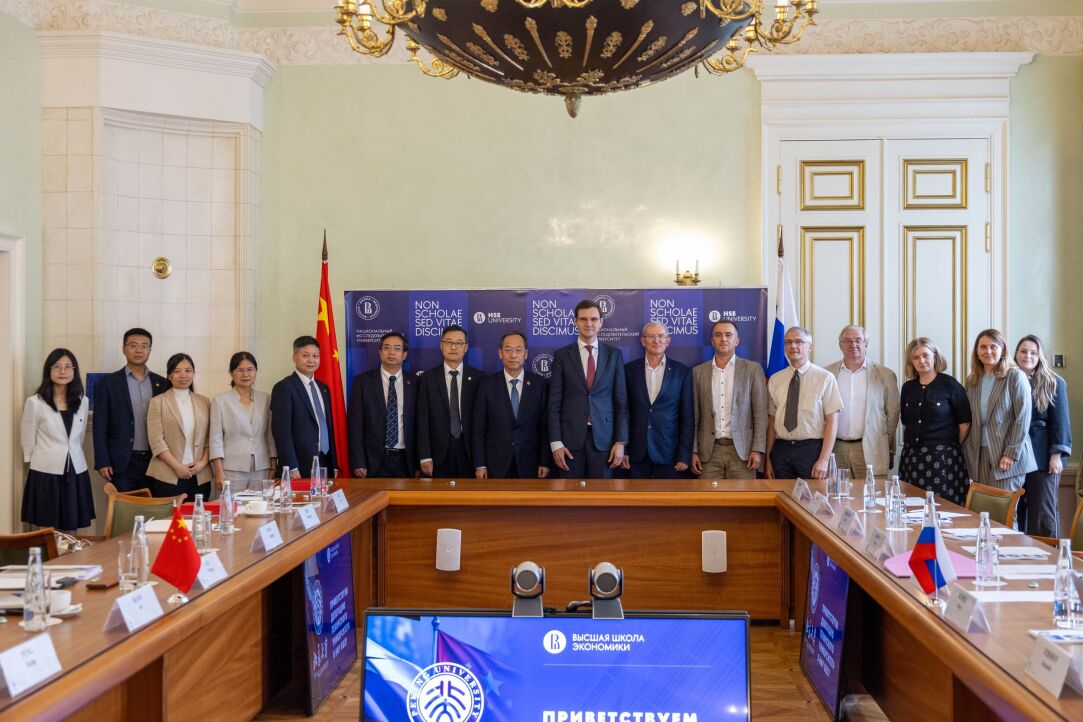
On July 21, 2025, representatives from Peking University led by Zhang Jin, Vice President of Peking University and Chancellor of Shenzhen Graduate School, paid a visit to HSE University. The delegation included forty students, teachers, and administrators. During their visit, leaders from both universities discussed potential areas for future collaboration, and representatives from three HSE University departments held meetings with Chinese students.
In the White Hall of Durasov House, members of the Chinese delegation were welcomed by Alexey Koshel, Vice Rector of HSE University. He expressed his gratitude to his guests for hosting the HSE delegation at Peking University in March, and stressed the importance of this visit as an opportunity to get to know each other better, identify shared interests, and initiate new joint projects.

Vice Rector emphasised that Peking University is rightfully considered one of the best universities in the world, and that developing cooperation with Chinese universities is a top priority for HSE University. He recalled that during the May visit of the Chinese delegation to Russia to commemorate the 80th anniversary of the Great Victory, Nikita Anisimov, HSE University Rector, and Gong Qihuang, President of Peking University, signed an agreement on cooperation in the fields of natural sciences and the establishment of a BRICS research platform in the presence of the leaders of Russia and China.
‘The signed agreements took our partnership to a new level, and our university staff are already working on new projects,’ said Alexey Koshel.
These include the joint research project ‘Development of Highly Efficient and Stable Perovskite Solar Cells,’ which was one of the winners of HSE University’s International Academic Cooperation competition in 2025. Another project is organising a joint section between HSE MIEM and Peking University’s College of Chemistry and Molecular Engineering at the International Conference on Quantum Materials and Technologies in Turkey in March. HSE University’s Faculty of Humanities is actively collaborating with Peking University’s School of Foreign Languages in the field of Russian studies, and HSE University’s Institute of Education maintains contact with colleagues from Peking University’s Graduate School of Education.
In turn, Zhang Jin, Vice President of Peking University and Chancellor of the Graduate School in Shenzhen, expressed his gratitude to Russian colleagues for their warm reception of the delegation, which included three additional working groups of students and teachers from Peking University. The first group met with representatives from HSE University’s Faculty of Chemistry, the second with representatives from the Faculty of World Economy and International Affairs, and the third group was received at the HSE MIEM building in Strogino.
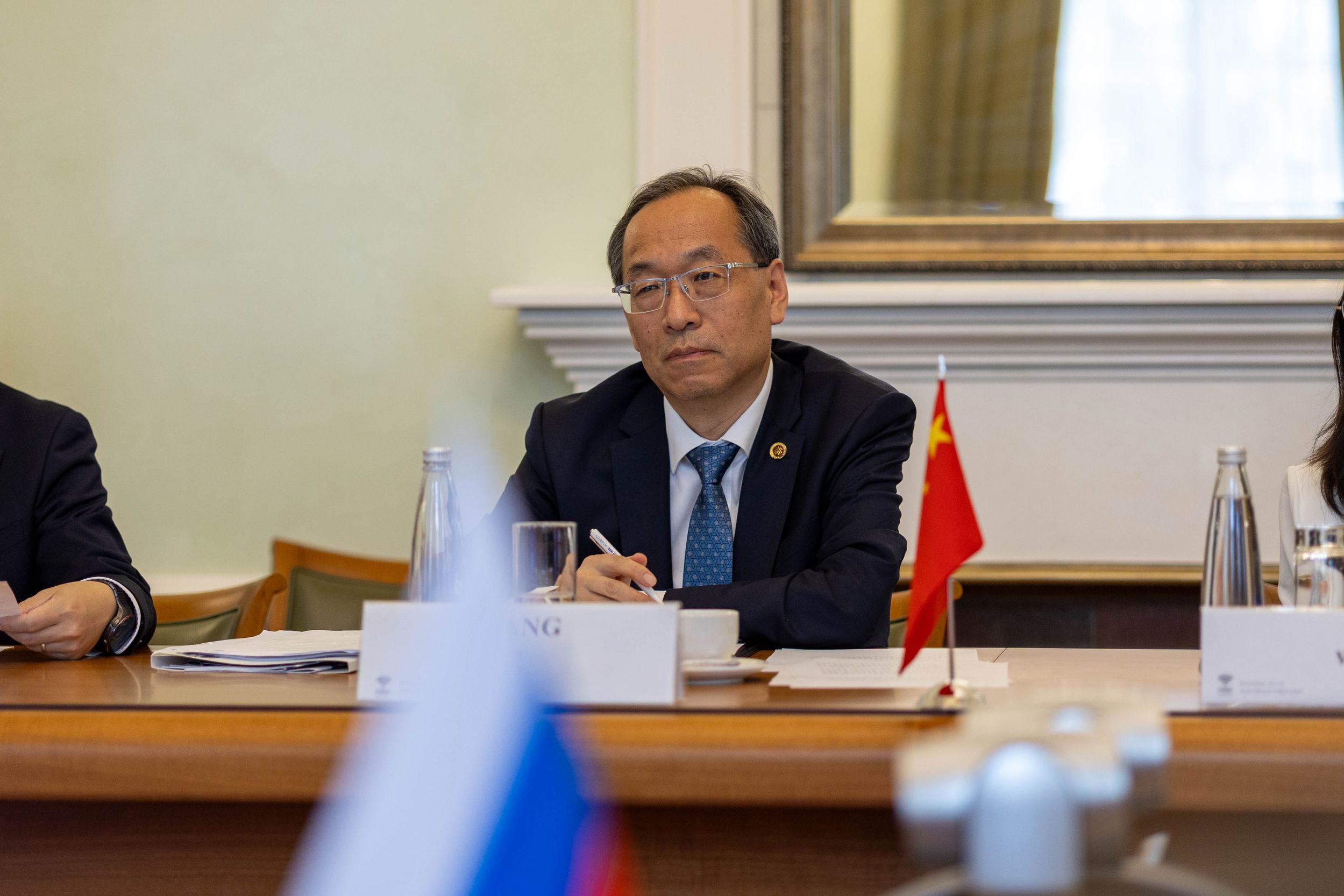
Professor Zhang described HSE University as one of the most significant partners in Russia and mentioned that it collaborates with Peking University in several fields. He introduced other attendees from China, who are in charge of cooperation in specific areas such as chemistry and materials science. He also shared his thoughts on the tour of the HSE University building on Pokrovsky Bulvar. ‘The library, dining area, and other spaces are very modern. It is clear that these were created for students,’ noted Vice President of Peking University.
He also mentioned the cooperation between the two universities, which takes place within the framework of interstate relations. He emphasised the need to expand academic exchanges and joint scientific work, taking into account the strengths of each institution. Professor Zhang suggested considering the possibility of creating a two-degree programme for graduate students, allowing them to spend half their time studying in China and the other half in Russia, with a supervisor from each country assigned to them.
In conclusion, he expressed hope that HSE University and Peking University could contribute significantly to strengthening the friendship between Russia and China.
Alexey Koshel thanked the distinguished guest for his kind words about HSE University and stressed that ‘truly significant projects are born through horizontal institutional collaboration between leading universities.’ Other members of the HSE University’s staff told the Chinese delegation about the future development of this collaboration.

Vitaly Kotov, Dean of HSE University’s Faculty of Chemistry, emphasised that five institutes of the Russian Academy of Sciences, which the faculty collaborates with in training students, should engage in joint projects with Peking University in the field of chemistry.
Alexei Vagov, Director of the Centre for Quantum Metamaterials at HSE MIEM, who had returned from Beijing the day before, supported the Chinese delegation’s proposal to organise student and postgraduate exchanges.

Yuriy Makhlin, Head of the International Laboratory for Condensed Matter Physics at HSE University and corresponding member of the Russian Academy of Sciences, spoke about his laboratory and the training of physics students at HSE University’s Faculty of Physics. He emphasised that this training was organised in collaboration with leading institutions of the Russian Academy of Sciences.
Marina Litvintseva, Director for Advanced Research at the HSE University, noted that within the framework of the university’s International Academic Cooperation project, HSE research centres and institutes had submitted 25 applications for joint work with Chinese colleagues in the past two years. One of these projects, with Peking University, was among the winners. ‘We would be happy to participate in the negotiations and initiate new projects to expand cooperation and the long-term agenda,’ she added.
See also:

Scientists Test Asymmetry Between Matter and Antimatter
An international team, including scientists from HSE University, has collected and analysed data from dozens of experiments on charm mixing—the process in which an unstable charm meson oscillates between its particle and antiparticle states. These oscillations were observed only four times per thousand decays, fully consistent with the predictions of the Standard Model. This indicates that no signs of new physics have yet been detected in these processes, and if unknown particles do exist, they are likely too heavy to be observed with current equipment. The paper has been published in Physical Review D.
HSE Scientists Reveal What Drives Public Trust in Science
Researchers at HSE ISSEK have analysed the level of trust in scientific knowledge in Russian society and the factors shaping attitudes and perceptions. It was found that trust in science depends more on everyday experience, social expectations, and the perceived promises of science than on objective knowledge. The article has been published in Universe of Russia.
Institute for Robotics Systems Established at HSE University
As decided by the HSE University Academic Council, a new Institute for Robotics Systems will be established at HSE, and with a strong fundamental base. It will cooperate with relevant departments across the university and engage students and doctoral candidates in research and development (R&D). First Vice Rector of HSE University and Director of the Institute for Statistical Studies and Economics of Knowledge, Leonid Gokhberg, discussed the expected practical results and the framework for cooperation with an industrial partner.
Eighth International U4U Online Seminar Unites Experts from 14 Countries
The HSE Online Campus hosted a two-day international U4U (Universities for Universities) seminar, which traditionally serves as a platform for exchanging expertise in online learning. This year, the event has reached a global scale, attracting international experts and representatives of universities from around the world. Together, they discussed key challenges and strategies for the development of online education. The online meeting was held in mid-November.
HSE Tops Ranking of Universities Participating in Priority 2030 Programme
The Russian Ministry of Science and Higher Education has published an updated list of participants in the Priority 2030 programme. A total of 106 universities will receive support this year. HSE University was included in the first group and topped the ranking.
‘Keep Working, Keep Publishing—Consistency Matters’
Ziyuan Zhu, from Beijing, China, is an international PhD student at the Institute for Public Administration and Governance at HSE University in Moscow. In this interview with the HSE News Service, Ziyuan talks about how studies can influence one’s outlook on life, comparing public service models in different countries, and why being a Chinese student in Russia is advantageous in research.
HSE Psycholinguists Launch Digital Tool to Spot Dyslexia in Children
Specialists from HSE University's Centre for Language and Brain have introduced LexiMetr, a new digital tool for diagnosing dyslexia in primary school students. This is the first standardised application in Russia that enables fast and reliable assessment of children’s reading skills to identify dyslexia or the risk of developing it. The application is available on the RuStore platform and runs on Android tablets.
HSE Scientists Optimise Training of Generative Flow Networks
Researchers at the HSE Faculty of Computer Science have optimised the training method for generative flow neural networks to handle unstructured tasks, which could make the search for new drugs more efficient. The results of their work were presented at ICLR 2025, one of the world’s leading conferences on machine learning. The paper is available at Arxiv.org.
Under a Blooming Magnolia: How Russian and Chinese Scientists Create Solar Cells of the Future
Schola continues to introduce the winners of the International Academic Cooperation competition. In today's issue, Professor Andrey Vasenko, Deputy Head of the Scientific and Educational Laboratory of Quantum Nanoelectronics at Tikhonov Moscow Institute of Electronics and Mathematics (MIEM), speaks about the joint project between his laboratory and the Peking University research team— ‘Engineering of highly efficient and stable perovskite solar cells.’
Physicists Propose New Mechanism to Enhance Superconductivity with 'Quantum Glue'
A team of researchers, including scientists from HSE MIEM, has demonstrated that defects in a material can enhance, rather than hinder, superconductivity. This occurs through interaction between defective and cleaner regions, which creates a 'quantum glue'—a uniform component that binds distinct superconducting regions into a single network. Calculations confirm that this mechanism could aid in developing superconductors that operate at higher temperatures. The study has been published in Communications Physics.